Why data matters
Why this industry still runs on paper.
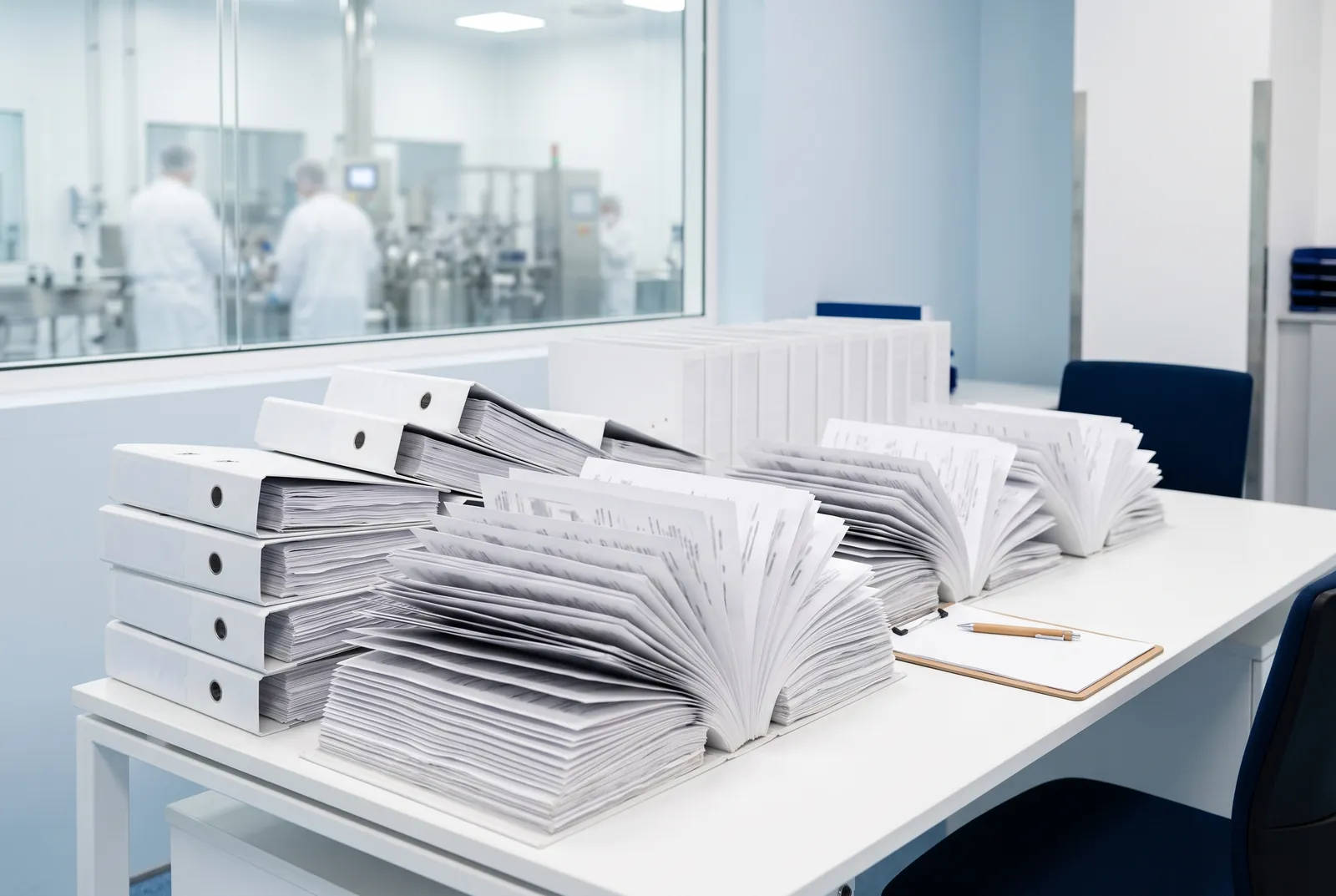
Not because the people are behind. Every time the industry gained momentum, the regulator tightened how data may be collected, shared and proven, and rightly so. The result is a manufacturing sector where the record is the product, and a long paper batch record is normal. Finding the one page an inspector will ask for is the job. Proving nothing else in the stack contradicts it takes weeks.
The journey
From islands of data to one source of truth.
Every plant we walk into runs on islands of data, and finding the truth takes weeks. Audits stake everything on that truth. There is a way out, and it has four steps.
- Your data lives on islandsOne process generates a tremendous amount of data, in every format, from every vendor, and each system keeps it locked in its own controller, database and reporting tool. Local databases, flat files, spreadsheets, a line historian, hand-written logs, paper reports. Islands everywhere, connected by nothing.
- Centralise the truthOne plant-wide historian becomes the single source of truth: every line's critical process data, collected automatically, landing in one place with its integrity intact. It is the first thing we stand up, and everything else builds on it.
- One line, one databaseLine databases move off the islands into centralised SQL, one database per line, never mixed. Queries cannot cross-contaminate, and work on one line's database may not require stopping or modifying databases on other validated systems.
- Navigable by everyonePublish it into one structured, real-time layer where every system and every person reads contextualised data in their own language. Operators see equipment status, quality sees batch data, engineers see trends, management sees the numbers.
What a plant generates
Six kinds of data, six systems, one batch.
Each system is correct. None of them was built to answer a question that spans the others, which is every question a batch investigation asks.
- 01Process and equipmentHistorian time-series from every instrument on the line211.188
- 02Batch and recipeMaster and executed records, phases, setpoints, operator actions211.186
- 03LaboratoryIn-process and release testing, stability, certificates of analysis211.194
- 04Quality and regulatoryDeviations, CAPA, change control, audit trails, validation records211.192
- 05Facility and assetRoom conditions, environmental monitoring, maintenance, calibration211.46
- 06MaterialComponent lot genealogy from raw material to finished product211.188(b)(3)
What is at stake
Islands do not just slow you down. They make regulatory audits difficult.
Regulators judge records against ALCOA+ (FDA 2018, MHRA 2018, PIC/S PI 041). A record assembled by hand from six systems can meet it, at the cost of the weeks, and every transcription is a point an inspector can test. Integrity is what turns thousands of entries into evidence you can stake an inspection on. Nine tests, each one stated below.
- AAttributableWho did it, and when. A user on every entry, signatures, audit trails.
- LLegibleReadable and permanent, for the life of the record.
- CContemporaneousRecorded as it happens. Automated capture, no retrospective entry.
- OOriginalThe first capture, preserved with its lineage.
- AAccurateCalibrated sources, verified calculations, no unauthorised change.
- +CompleteEvery record checked for what is missing, not a sample of them.
- +ConsistentSequenced, time-true records across every source.
- +EnduringRedundant collection and retention for the record's life.
- +AvailableOn demand, across the plant, for the whole retention period.
The structural argument
A historian excels at numbers. A database excels at text.
A process historian such as PI excels at storing manufacturing process data, particularly numeric time-series. It is less efficient with text-based data such as audit trails, batch information and user data. Some claim a historian can store those records, but its long, narrow data structures are not ideally designed for them. A relational database such as MS SQL manages text-based data effectively, but lacks the historian's built-in optimisation for time-series process data.
Neither is wrong. Neither is sufficient alone. encompass360 layers data from multiple, disparate sources and vendor systems, the historian, the building management system and SQL, so a reviewer does not have to join them by timestamp and hope.
"Viewing data is one thing. Putting data in context is a completely different endeavor."
a controls engineer, r/PLCHow we work
Four principles for plant technology.
- Open architecturesOpen architectures let us select the best technology available for each particular function. Closed designs lead to stagnation.
- Never one source for everythingEven when a company offers high-quality hardware or software, it is not advisable to standardise every component on a single supplier.
- Minimise complexityIf we are struggling to make a piece of hardware or software fulfil a key requirement, it is probably a good time to evaluate alternative solutions.
- Build it ourselves, as a last resortCustom solutions can solve problems off-the-shelf products cannot, but they should be considered only as a last resort.
Next step
No more islands of data.
Bring the data problem that has been costing you. We will show you the path out on a line like yours.